
For collectors who demand absolute visual perfection, the defining elements of a high-end replica do not stop at the movement or the case geometry. True horological enthusiasts know that the ultimate test of a top-tier timepiece lies in the microscopic details—the features invisible to the naked eye but critical to the watch’s structural authenticity.
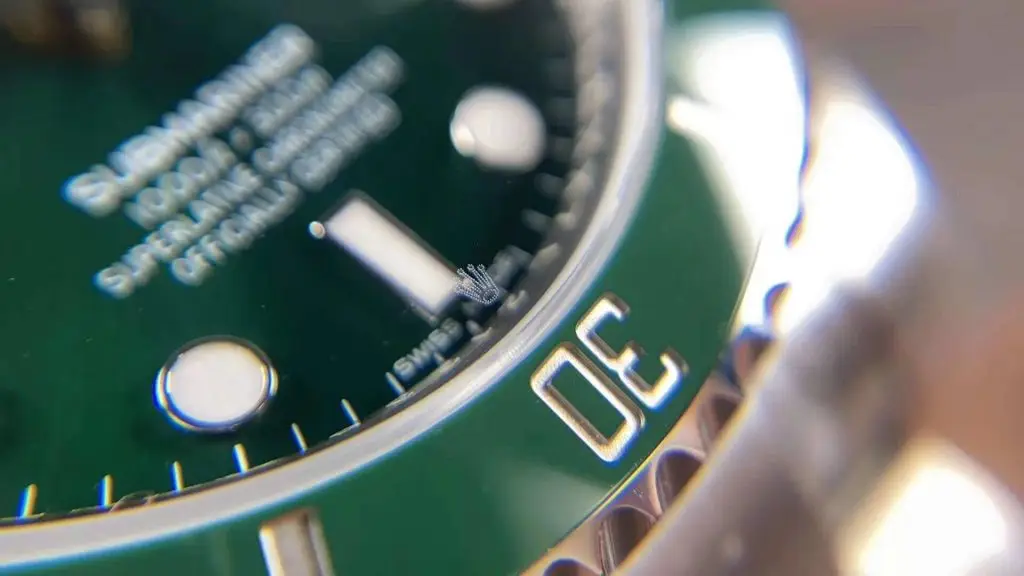
Chief among these micro-features is the Laser-Etched Rolex Super Clone Crown (LEC) located on the sapphire crystal. In the rapidly advancing world of 1:1 super clones, mastering this exact detail has separated the elite manufacturers from the rest. Here is a deep dive into the engineering behind the LEC and how modern super clones match the exacting specifications of the genuine article.
Laser Etched Rolex Super Clone Crown
Starting around 2002, Rolex introduced a sophisticated anti-counterfeit measure on its modern models: a minuscule coronet etched directly into the sapphire crystal at the 6 o’clock position. The objective was simple. It was meant to be a hidden security feature that required specialized tools, precise lighting, and a jeweler’s loupe to identify.
For years, this tiny detail functioned exactly as intended. Early counterfeiters lacked the precision laser technology to replicate the crown accurately. They either omitted the etching entirely or, worse, etched it so deeply and solidly that it became a glaringly obvious white logo visible from across the room.
The Pointillism Technique: Genuine Specifications
To understand why the LEC is so difficult to replicate, you must look at how the authentic crown is manufactured.
A genuine LEC is not a solid, continuous line carved into the glass. Instead, it is created using a technique similar to pointillism. Hundreds of microscopic dots are laser-engraved at varying depths within the sapphire crystal to form the shape of the crown. Because the dots are suspended at different layers inside the glass rather than sitting purely on the surface, the etching reflects light in a highly specific, elusive manner.
If you can easily see the crown without a flashlight or a loupe, the crystal is undeniably fake. The hallmark of a perfect LEC is its near-invisibility.
How 1:1 Super Clones Mastered the Micro-Details
Today’s elite replica factories, have poured immense resources into reverse-engineering this specific feature. Just as they mastered the metallurgy for perfect 904L steel watches, these manufacturers upgraded their multi-axis laser engraving machines to mimic the exact dot-matrix pattern of the genuine crystal.
Modern 1:1 super clones now feature an LEC that behaves exactly like the authentic version:
- Varying Dot Depths: The clones utilize the same pointillism technique, meaning the crown is comprised of distinct dots rather than a frosted, solid line.
- Correct Sizing and Placement: The crown is perfectly centered exactly above the 6 o’clock hour marker, maintaining the microscopic proportions mandated by genuine specifications.
- The “Invisible” Standard: In a massive leap forward for authenticity, the LEC on top-tier clones is incredibly difficult to spot with the naked eye. In fact, many new buyers mistakenly believe their clone is missing the etching entirely, only to discover it later under professional lighting.
The Flashlight Test: Inspecting Your Crystal
If you want to verify the macro-details of your super clone’s crystal, you cannot simply hold the watch up to the sun. To properly view a top-tier LEC, you need to replicate a jeweler’s inspection environment:
- Move into a dimly lit or completely dark room.
- Hold the watch so the 6 o’clock marker is backed by a dark section of the dial, maximizing visual contrast.
- Take a bright LED flashlight (a smartphone flashlight works perfectly) and shine it horizontally across the surface of the crystal directly from the 12 o’clock position.
- Use a 10x jeweler’s loupe or your smartphone’s macro camera lens to zoom in on the edge of the glass just above the 6 o’clock marker.
When the light catches the internal engravings at the correct angle, the microscopic dotted crown will suddenly illuminate, glowing faintly within the sapphire.
For high-intent buyers seeking the pinnacle of visual perfection, the flawless execution of the laser-etched crown proves that modern super clones are no longer just visual approximations—they are 1:1 micro-engineered masterpieces.